







 2026-07-01 18:00
 By MOMAY


Why Your Diamond's Certificate is the Ultimate Dealbreaker
Not all grading reports are created equal. Discover the industry secret behind "Soft Grading" and how to protect your investment.
 By now, you have probably mastered the 4Cs: Carat, Cut, Color, and Clarity. You are comparing prices online, and you find two diamonds with the exact same specs (1.00ct, G Color, VS1). But there is a catch—one is priced 20% cheaper than the other.
Is it the deal of a lifetime? Probably not. The price difference usually comes down to the piece of paper that accompanies the diamond: The Grading Certificate. At KESONLY, we consider certification to be the unofficial "5th C." Here is how to navigate the complex world of diamond labs and avoid the trap of inflated grades.
1. What is a Diamond Certificate?
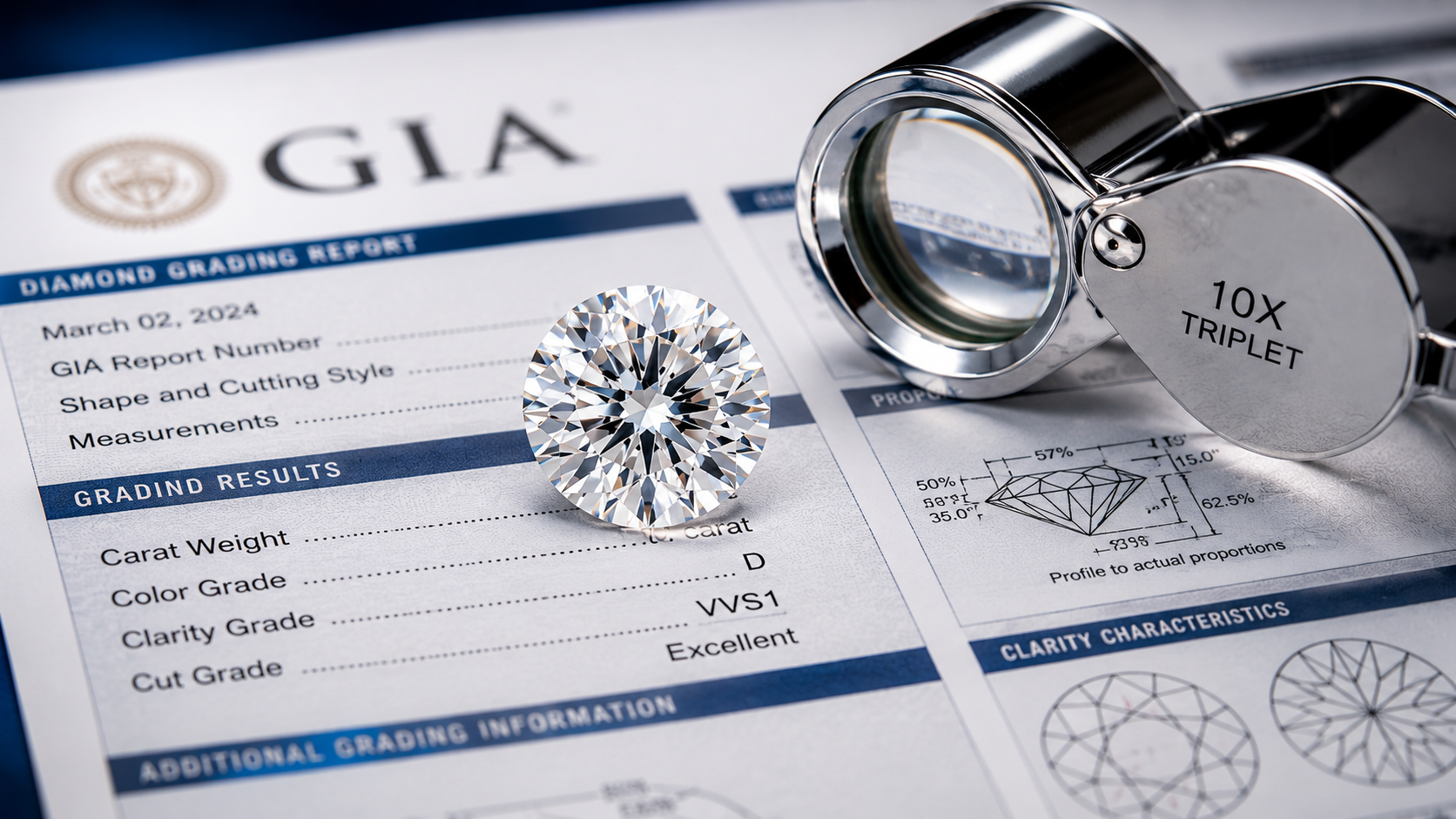
A diamond grading report (or certificate) is an official blueprint of your diamond. Issued by an independent gemological laboratory, it maps out the diamond's exact dimensions, flaws, polish, symmetry, and confirms whether the diamond is natural or lab-grown.
Crucial Note: A certificate is not an appraisal. It does not state the monetary value of the diamond; it only states its scientific characteristics.
2. The Danger of "Soft Grading"
Diamond grading is done by humans, and human eyesight can be subjective. Because of this, different laboratories have different standards of strictness.
Some lesser-known labs practice "Soft Grading." This means they might grade a diamond as an "F" Color and "VS1" Clarity, when a strict lab would have graded that exact same stone as an "H" Color and "SI1" Clarity.
When you buy a soft-graded diamond, you think you are getting a huge discount on a premium stone, but you are actually overpaying for a lower-quality diamond.
3. The Top Laboratories: GIA vs. IGI
To ensure you get exactly what you pay for, you should only buy diamonds certified by the most reputable, globally recognized laboratories.
| Laboratory | Reputation & Strictness | Best Suited For |
|---|---|---|
| GIA (Gemological Institute of America) | The Absolute Gold Standard. GIA invented the 4Cs. They are the strictest, most consistent, and most respected lab in the world. A GIA grade is undisputed globally. | Natural Diamonds. If you are buying a natural diamond, a GIA certificate is highly recommended to hold its long-term value. |
| IGI (International Gemological Institute) | Highly reputable and very consistent. While slightly looser than GIA historically, they are currently the undisputed market leader for grading Lab-Grown diamonds. | Lab-Grown Diamonds. IGI provides highly detailed specs for lab diamonds, making them the most trusted choice in the lab-grown sector. |
4. The "In-House" Certificate Red Flag
If a jeweler tries to sell you a diamond with a certificate issued by their own company (an "In-House" appraisal), walk away.
This is a massive conflict of interest. A jeweler grading their own diamond will almost always inflate the quality to justify a higher price. Always demand third-party, independent verification.
5. The Laser Inscription: Your Proof of Identity
How do you know the certificate matches the diamond in your ring? Almost all modern diamonds graded by GIA or IGI have their unique certificate report number laser-inscribed on the diamond's girdle (the thin outer edge).
This inscription is microscopic and invisible to the naked eye, but any jeweler can show it to you under 10x magnification. It acts as your diamond's permanent license plate.
Transparency is Our Promise
At KESONLY, we don't play games with "soft grading." We exclusively curate our natural diamonds with GIA reports and our lab-grown diamonds with IGI or GIA reports.
Every diamond we sell can be verified online through the laboratory's official database, and we will gladly show you the laser inscription before you make your purchase.
Shop Certified Diamonds with Confidence